Pages

Showing posts with label Characteristics. Show all posts

Tuesday, October 29, 2013

The Characteristics of the Desert Tortoise


Welcome to my world

The Desert tortoise is an herbivore reptile that resists even when the temperatures grow to 60 degrees Celsius, because of its capacity to dig galleries. This turtle spends its entire life in those galleries that offer shelter during the cold season, from November to march. The galleries can be simple, but also complex, spread on a few meters. The desert turtle can have tens of hideouts of this kind. Those can be used, in different periods, by several tortoises.

The desert tortoise weights 5-9 kilograms and it measures 40 centimeters or even more. The shell is high, and the growing lines are highlighted. The superior part of the carapace is rounded and brown, and the inferior line is flat and yellow. It has a big head compared with the body, and a short tale. The inferior members are strong, while the superior ones are flat, as this way, it is easier to dig.

When the tortoise is scared, or when she wants to avoid dangers, the tortoise makes some sounds that have the goal to scare the predator. The visual and smell senses are well developed, but the sounds are of low frequency, so they are rarely effective.


The desert tortoise lives about 80-100 years, which is a record even for tortoise. They reach maturity after 15-20 years. From November to March, this tortoise hibernates. Those reptiles are well adapted to the dry land where they live. They dig basins where they collect rainwater, and they can wait for days for it to fill. In the rest of the year, they take the water necessary from the moisture on grass and wild flowers that they eat during the spring. It is interesting that this reptile can live one year without drinking water.

The natural habitats of this tortoise are the rocky areas from the Mojave and Sonoran deserts, and in Southeastern California. It eats weed and wild flowers, cactuses and fruits, especially during the spring, when they get out of hibernation.


The number of eggs lay by the female varies considering the dimensions of the female. A mature female can lay eight eggs in a nest. In one season, the female can make two-three nests. Once the eggs are in the hole, the nest is covered with sand. The incubation period is of 90-120 days. A phenomenon is interesting, because considering the temperature of the environment, males can hatch (26-30 degrees), or females (30-33 degrees). It is one of the fewest species that has this characteristic. Moreover, the desert tortoise is one of the fewest that actually watches the nest. Even if the nests are situated far from the “residence” of the mother, they are protected under a tree or in the shadows of a rock.

The baby tortoises grow considering the quantity of food that they have at their disposal and they are not defended and fed by their parents. In one year, their carapace can create more rings, so their age can’t be established using these criteria. It is a protected species since 1990.

Related Posts:

Characteristics of Russian tortoises

Characteristics of the Radiated Tortoise

Characteristics of the Sulcata Tortoise

Monday, October 28, 2013

Characteristics of Russian tortoises


The Russian tortoise is a special type of the Testudo family. It is adapted for the cold weather of Europe and Russia, although it can be found in other parts of the world. It is suited as a pet because it is easily adaptable, and it is common in pet stores.


The Russian tortoises drink water. You will need to ensure enough quantity, but make sure that the tortoise can’t enter the recipient. Moreover, the water recipient in the pen must be fixed, as the tortoise will surely spill the water otherwise.


The Russian tortoise digs a lot. The habitat of this tortoise must be made on a layer of sand and mud of at least 10 centimeters. Normally, if the tortoise receives the required quantity of food and light, it will not need to hibernate. However, the nature takes its course, so even if the pet does not want to hibernate, it will want to dig holes to prepare. If the sand is not deep enough, you will take the most important pleasure of your pet away.


The Russian tortoise adapts easily to captivity, and it has the same behavior. It is not recommended to buy this type of tortoise if you live in a hot area, as it will almost certainly die. Even if you are able to ensure the right temperature, it is impossible to stimulate the humidity required by this tortoise.


The food for a Russian tortoise is also delicate. This species is adapted to the harsh conditions of the steppe. This means that she will look for weeds and sparse plants. You might believe that you will make the pet happy if you give it enough food. It is not true. The natural behavior of the tortoise is to look for food and to fight for every weed, so it will not feel that great with a bowl full of lettuce.


During the summer, you can keep the tortoise in an external pen. Here, it can dig as many holes as she wants, and she will feel perfect. During the winter, if you don’t have enough room in your house, at least try to create a proper environment for hibernation. The behavior of Russian tortoises is changeable. If the turtle did not hibernate this year, it does not mean that she will not want to do so the next year. Anticipating the wishes of your pet is the real challenge of growing a Russian tortoise.  

Sunday, October 27, 2013

Characteristics of the Radiated Tortoise


The Radiated Tortoise grows up to 40 centimeters, and it can weight about 15 kilograms. The radiated tortoise is considered one of the most beautiful, because it has some nice colors that can’t be found with many other tortoises. Moreover, its legs that look like the ones of elephants are also interesting.

The name of this tortoise comes from the yellow stripes in the carapace, which looks like radiated rays. From this point of view, this tortoise looks alike the Indian Star Tortoise, but according to specialists, this tortoise looks a lot better. This tortoise is also bigger and it has a smoother carapace. The males of this species have longer tails. The radiated tortoises live in a limited area of Madagascar, but the efforts of different organizations increased the habitat of those tortoises in the neighbored island if Reunion. The radiated tortoises live in dry areas and forests, where they can find abundant resources of food.


This tortoise is predominantly herbivore. They are diurnal, looking for grass, fruits and plants all day long. This forms about 75% of their diet. They even eat cactuses, but only certain kinds. The radiated tortoises are social, and they like to stay in groups, in areas where they can find food. An area covered by those tortoises is noticed immediately, because the grass is perfectly trimmed. In the areas where Opuntia cactus can be found, there are surely some radiant tortoises, as they like this cactus more than anything else. This cactus is useful for tortoises, as it contains proteins and fibers required especially by young exemplars to grow. 

It is almost impossible to have a radiant tortoise as a pet because of several considerations. First, they are protected by laws, so importing them in another country without a serious reason is forbidden. If you have the authorizations required for this, you will need to prove that you can create a habitat just like the natural ones. Third, considering the fact that they are rare, those tortoises are also expensive. If you want such a tortoise as a pet, you will need financial and logistic resources. In captivity, it is important to give the tortoises food that resembles with the cactuses, such as kale and chicory.


The males reach sexual maturity when they are 30 centimeters long, and the females reach theirs when they are 35 centimeters. The male starts his “attacks” by sniffing the female and circling her. Sometimes, the male has to immobilize the female, to prevent her from running away. In case another male is in the vicinity, a fight will probably start. The fight is violent, and usually, the male that suffers the first injury is considered defeated. Unlike other species, those tortoises don’t fight to death. The female lays 3-12 eggs in a hole of 15-20 centimeters, and then it is covered with sand. Incubation for this species lasts for a long time, for 5-8 months, and some of the nests are discovered and destroyed by predators during this time. The babies have a white color, they are really different from adults, but they will soon begin to change, a few weeks after being born. 

Related Posts:

 Characteristics of the Sulcata Tortoise


Important Tortoise Facts

The Box Tortoise and Hibernation

Thursday, October 24, 2013

Characteristics of the Sulcata Tortoise
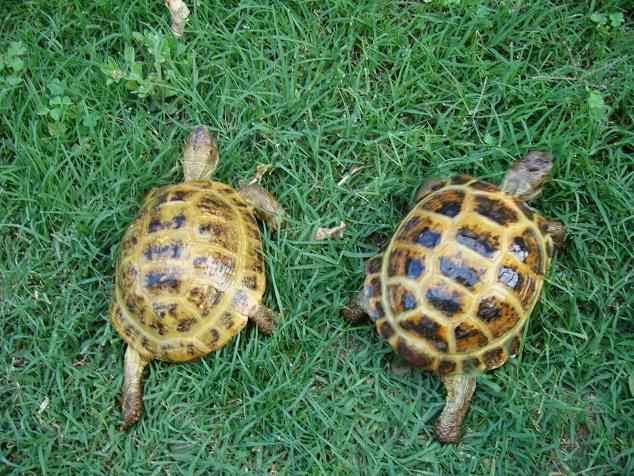


The Sulcata tortoise is a species coming from North Africa, but which lives in the South East of Europe, and in the Middle Orient. It is frequently met in the Mediterranean Basin. It prefers the semi-desert areas, with dunes of sand. However, it also likes the forests, and it can reach altitudes of 1000 meters.

The length of the carapace is of 20-25 centimeters, but some can reach 3.5 centimeters. The surface of the shell is smooth and rounded, and the grey color has black dots. The carapace has a yellow green color. For males, it is concave, and for the young exemplars and the adult females, the carapace is flatter. The smell is the most important sense, but the Sulcata tortoise also sees perfectly, and it can distinguish colors and shapes. The Sulcata tortoise needs to spend the first hours of the day in the sun, with the goal of increasing the body temperature, and to reactivate the metabolism.

During the reproductive period, which takes place at the end of May, the female lays 2-8 eggs in humid soil. She digs the holes with the posterior members. She is pretty fast, being able to dig in one quarter of hour. She uses the force of members and the sharp claws for that, and then she covers the hole with sand, to protect them from predators and cold. After 2-3 months, the eggs hatch, and the little tortoises start their fight for survival. They are an easy prey for birds, and their carapace is soft, so they are a wanted prey for all kinds of predators.

The small turtles reach sexual maturity around the age of 14, and they can survive in captivity for 100 years. Their food is mainly composed of dry leaf, but also insects and worms. In conditions of captivity, the tortoise eats salad, citric fruits, bread and milk. However, they always need leaf for fibers and calcium. This type of tortoise is a vulnerable species and it is threatened by extinction.

Friday, October 11, 2013

The Sea Turtles: General Characteristics


The Sea Turtles are not suited as pets, because they are protected by the law. Even if you are able to find one, besides the fact that it is illegal to keep them in captivity, you will also need a special place to raise it. Imitating the natural habitat of the sea turtles is almost impossible, because you will need fresh seawater all the time. The only method to keep a sea turtle is to make a fence in the sea and on the shore, where the turtle can live. Even so, the turtle will not be happy. A turtle needs to migrate and it can swim for days to find the special beaches where to lay eggs, so the freedom of the turtle is limited.

The Sea Turtles are almost extinct in some parts of the world, because of massive hunting and because of wild animals. The most important moment in the life of a turtle is the…beginning. The eggs must be put at about 50 meters from the sea, and the small turtles need to reach the water as soon as possible to survive. Many of them are not able to do so, especially because the mother leaves the “nest” as soon as the eggs are buried. As there is nobody to help the little turtles, many of them don’t make it because of the wild animals. Eagles and birds learned to lift the small turtles in the air, and to smash them on stones. The turtles need some time to reach the water, and during this time, they are exposed to such attacks. Even the ones that are able to reach the water don’t survive all the time, as there are other animals there hunting them.

The shells of the turtles are their most important weapons. It is one of the best defensive methods invented by nature. Practically, besides smashing it, there are no other ways to crack the shell of a turtle. Even so, the sea turtles are in danger. Especially those living in highly populated areas and industrial areas die because of pollution. The turtle eggs are delicious, and even if it is against the law, there are many people searching for those eggs. Practically, even if a turtle can lie up for 20 eggs in one nest, only ten are able to survive and reach the sea, and from those, only four or five will reach maturity.

Why Are The Sea Turtles Not Suited As Pets?

The Decision of Having a Turtle as a Pet